Galaxy S21: Samsung Didn't Bring Back The Headphone Jack And Here's Why
Galaxy s21 samsung didn t bring back the headphone jack and charger galaxy s21 samsung didn t bring back the headphone jack and usb galaxy s21 samsung didn t bring back the headphone jack and volume galaxy s21 samsung didn t bring back the headphone beats galaxy s21 samsung didn t bring back the time galaxy s21 samsung didn t bring back the big galaxy s21 samsung didn t bring back the glory galaxy s21 samsung didn t bring back the bush galaxy s21 samsung didn t bring back synonym galaxy s21 samsung didn t bring your phone word scramble galaxy s21 samsung phone galaxy s21 samsung song in commercial tv galaxy s21 specs samsung galaxy s21 plus

Galaxy S21: Samsung didn't bring back the headphone jack and here's why
This story is part of CES, where CNET covers the latest news on the most incredible tech coming soon.
Samsung's Galaxy S21 , the follow-up to last year's Galaxy S20, has arrived earlier than the company's flagship phones usually do. (Here are CNET's Galaxy S21 review and Galaxy S21 Ultra review.) Samsung hosted a virtual Unpacked event earlier this month in which the latest Galaxy S smartphone was unveiled, about a month earlier than last year's announcement. And today the Galaxy S21 line officially hits shelves. Here's how to buy one.
Rumors had been circulating for months about the new device, fueled by leaks galore. Would the Galaxy S21 come with a stylus? Would it sport a sleek new design? Would it replace the Galaxy Note line?
And the perennial question: Would it include a headphone jack? We now know the answer: No, the Galaxy S21 does not have a headphone jack.
We guessed as much ahead of the Unpacked event, based on leaks. But if we learned anything in the time since Samsung released its last Galaxy S flagship (the very same day the coronavirus disease was officially christened COVID-19), it's that anything is possible.
Leaked teasers for the Galaxy S21 showed a similar design to the S20 lineup, with an in-screen fingerprint reader and a centered hole-punch front camera. But one thing we didn't see in the leaked images is a headphone jack, which told us it was probably not in the cards for the S21. More recent leaks showing Samsung's specs for all three models of the S21 also did not include mention of a headphone jack.
There had been some unsubstantiated conjecture about Samsung reintroducing the headphone jack as a sort of experiment in 2021. The thinking here is that a headphone jack could be enough to differentiate the Galaxy flagship from other premium phones from the likes of Apple and Google, which have also forced users to convert to either the wireless earbud or dongle lifestyle in recent years.
It was an interesting theory, especially if you remember Samsung's initial reaction to Apple's original removal of the headphone jack from its 2016 handset, the iPhone 7. Apple's move became a punchline at Samsung's Galaxy Note 7 launch event that same year. And ads for the Galaxy Note 8 went a step further, mocking the iPhone's unwieldy dongle setup. But the tide changed and, when Samsung unveiled its Galaxy Note 10 in 2019, it, too, left the headphone jack on the cutting room floor. Last year's Galaxy S20 also lacked a headphone jack, the first of the Galaxy S line to nix it.
Read more: iPhone 12's Lightning port may be the next thing Apple kills
History repeated itself with the Galaxy S21. When Apple decided not to include a charger or earphones in the box with its iPhone 12, Samsung mocked that decision as well. But now Samsung followed suit and also nixed them. A leak from tipster Evan Blass the day before Galaxy Unpacked also showed a "what's in the box" page from Samsung that only listed a USB-C cable (sans charging brick), ejection pin and Quick Start Guide, citing environmental reasons. And not including headphones in the box was yet another piece of evidence against the inclusion of a corresponding headphone jack.
Read more: With no charger or expandable storage, the Galaxy S21 is more like the iPhone 12 in some of the worst ways
One reason phone makers love to lose the jack: thinner bezels. Thin is in, and a smaller bezel footprint allows for a larger screen without adding to the phone's overall size.

Another, perhaps more cynical reason: The company's own wireless earbuds ought to sell better when its phones lack a wired headphone jack. Apple's AirPods have sold like gangbusters, likely thanks in no small part to the iPhone's excised jack. And Samsung's got its own line of wireless earbuds, the Galaxy Buds, Galaxy Buds Plus and Galaxy Buds Live, and now, there are the Galaxy Buds Pro, too. So it makes a lot of sense for Samsung to stick to its decision to bid the headphone jack adieu.
§
Ports have been a fixture on mobile phones since their inception -- dating all the way from the iPhone 12 back to "dumb phones" from decades before. But even when it comes to ports, Apple has done things its own way. In 2012, the company made its own accessories obsolete when it switched from a 30-pin connector to a proprietary Lightning port, and has since resisted from switching to a USB-C connector on iPhones even though it eventually became accepted as a universal standard. (There are Lightning-to-USB-C cables, however.)
But if long-running industry rumors are to be believed, Apple is planning to kill the Lightning port on the iPhone, making way for a completely portless phone. One of the latest indications we're moving closer to this port-free life is Apple's introduction of MagSafe on the iPhone.
Read more: Here are CNET's reviews of the iPhone 12 and iPhone 12 Pro, iPhone 12 Mini and iPhone 12 Pro Max.
The wireless charging system relies on an embedded array of magnets that snap the iPhone 12 onto a MagSafe puck. To charge your iPhone 12, rest it on the circular charging pad, then wait for the charging indicator on the screen to confirm it's working. This eliminates the need for a Lightning connector, and while Apple kept the port on the iPhone 12, it did remove the wall adapter and wired earphones from its box.
After the addition of MagSafe, a wireless future seems inevitable for the iPhone. It offers a glimpse into Apple's vision where a cord-free iPhone accessory ecosystem is made possible by magnets, not ports.
"Wireless technologies have reached a level of maturity where a portless device is much more viable than it's ever been," said Tuong Huy Nguyen, senior principal analyst at Gartner.
Some Chinese phone-makers have also beaten Apple to the punch, launching portless phones of their own. And many examples of emerging tech, like VR headsets and smart glasses, are wireless too. Whether Apple will head down this path remains to be seen, but there are many reasons why the time is right for Apple to finally introduce a portless iPhone.
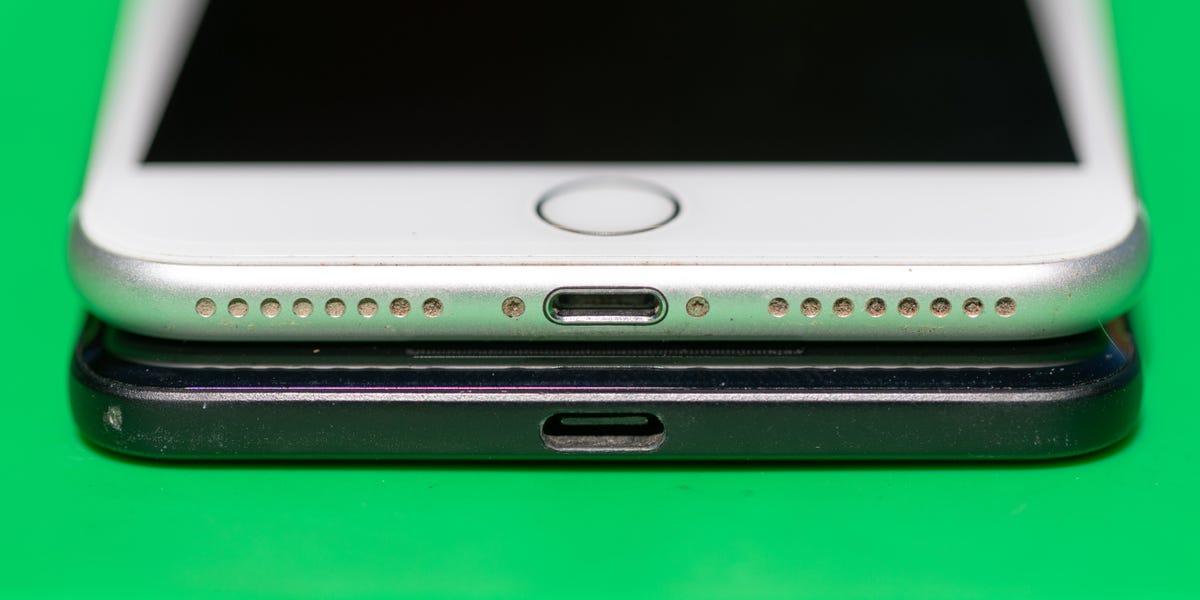
An iPhone 7 Plus with a Lightning port sits atop a Google Pixel 2 XL with a USB-C port.
Stephen Shankland/CNETApple is making more things wireless
Ports are a practical conduit for phones to deliver three key functions: charging, data transfer and audio output. Before adding MagSafe to its phones, Apple developed AirDrop and iCloud for data transferring. As for audio, Apple kicked off the mainstream trend of wireless earbuds in earnest when it introduced the first-gen AirPods in 2016.
Apple also unveiled a MagSafe-compatible leather wallet that clips on to new iPhones and costs $59.
AppleMagSafe is the wireless bridge to wired accessories
MagSafe is Apple's answer to wireless charging for the iPhone 12. But to convince more people to live without a Lightning port, Apple needs to offer a wireless bridge for other wired accessories. MagSafe seems to serve exactly that purpose, opening up possibilities for a whole new world of iPhone attachments that magnetically snap on.
These accessories could include "game controllers, camera grips, selfie sticks and, yes, wireless charging battery packs that could change the way we hold or interact with an iPhone," according to CNET executive editor Roger Cheng.
A few official MagSafe accessories we've already seen include Belkin's car dock and a combo iPhone/Apple Watch charger. The move to MagSafe also indicates that iPhones probably won't get USB-C.
Apple keeps improving wireless charging
After holding out for years, Apple embraced wireless technology in 2018 when it added support for the Qi-based wireless inductive charging standard to its iPhone 8 and iPhone X. Apple initially limited the power to just 5 watts, but later boosted it to 7.5 watts via a software update. This was an indication that Apple was regarding wireless charging not as a specialty feature, but as a necessary one.
There's also chatter about a new wireless charging pad in the works to replace AirPower, which was ultimately canceled before it had a chance to hit the market. Rather than charging multiple devices simultaneously like the AirPower promised, this Qi pad would likely charge one device at a time.
Apple's MagSafe charging system relies on magnets to autoalign the charging puck with any phone from the iPhone 12 family.
AppleNow Apple says MagSafe works even faster than Qi chargers. Its charger now offers twice the amount of power at 15 watts, which could bring it on par with the Quick Charge technology that Android phones have long enjoyed. Admittedly, Apple has some catching up to do versus Chinese competitors such as Xiaomi and Oppo, but overall the industry is charging forward.
For many years, wireless chargers have been painfully slow compared with their wired counterparts, taking nearly twice as long in some cases. But that gap is narrowing. Earlier this year, Oppo launched a 65W wireless charger, dubbed AirVOOC, that it says can fully charge a battery in 30 minutes. Meanwhile, Xiaomi is working on an 80W wireless charger that promises to fully refill a 4,000-mAh battery in under 20 minutes.
Apple has killed once-standard features and will likely do it again
Apple isn't above axing popular product features even if people crave them years after they've gone. Apple killed the DVD disc drive in its Macs, for example, and it bid farewell to the headphone jack by removing it from the iPhone 7 in 2016. Longtime Apple executive Phill Schiller said that took "courage," positioning it as an innovative shift away from outdated technology. "It makes no sense to tether ourselves with cables to our mobile devices," Schiller said when Apple unveiled the AirPods at the same event.

Apple unveiled its first-gen AirPods in 2016 alongside the iPhone 7 line, which were the first iPhones to ship without the standard 3.5mm headphone jack
Though many decried the move, other phone-makers followed Apple's lead. Samsung, OnePlus, Google and others dumped the 3.5mm headphone jack from their flagship phones soon after, leaving a USB-C port in its place.
Apple still sells tens of millions of iPhones and AirPods every year, proving that many people are willing to adapt to its newer tech.
"A smartphone is a device with limited space for all the components, but it will also be important for the smartphone makers to provide better or more functions to stay competitive," said Research Manager Will Wong at IDC's Asia Pacific. "Thus, a portless phone is likely to be an unavoidable trend."
A portless iPhone will allow Apple to better differentiate between models
Apple analyst Ming-Chi- Kuo predicts that Apple will launch a portless flagship iPhone by 2021. Kuo reported that having a wireless phone will "create more differentiation" between top-tier iPhones and base-model iPhones. Going by iPhone 12 naming standards, this would mean it's possible that the iPhone 13 Pro and 13 Pro Max would be portless, while the iPhone 13 Mini and regular iPhone 13 would keep their Lightning port.
"We expect that the highest-end model would cancel the [Lightning] port and provide the completely wireless experience," Kuo wrote in a 2019 report.
Differentiating more between models could make it easier for Apple to command higher prices for its fancier iPhones. These would target people with bigger budgets who care about being on the cutting edge of Apple's technology.
Apple wouldn't be the first to experiment with a port-free phone
Apple usually isn't the first to jump on mobile phone trends. It wasn't the first to release phones with 5G or wireless charging, and we've yet to see a foldable phone from Apple. So it's not surprising that there are already portless phones in existence, either. Chinese phone-maker Vivo launched a port-free and button-free Apex concept phone last year, which relies on a magnetic clip that connects behind the phone for charging. It also has virtual pressure-sensing buttons instead of physical buttons, but it's not available for the mass market yet.

Chinese phone-maker Vivo launched a port-free concept phone last year called the Apex 2019 (pictured) that it followed up this year with the Apex 2020.
Aloysius Low/CNETNo ports would also mean more durability
Whenever Apple closes off a port, a chorus of criticism over forced obsolescence tends to follow, among other things. Some iPhone users feel Apple is robbing them of perfectly fine input points.
Those accusations aside, sealing off ports could make iPhones more durable. The logic is this: Having no ports means fewer seams and therefore fewer opportunities for dust and water to get into the phone. It also means fewer points of vulnerability for cracks.
Apple has been equipping its iPhones with features designed to improve durability. This year the company placed emphasis on the ceramic shield screen on its new iPhone 12 models. It also introduced water resistance to iPhones in 2016.
Source

